



Efekta’s model for digital transformation: What Vietnam can learn from AI teaching platforms at national scale

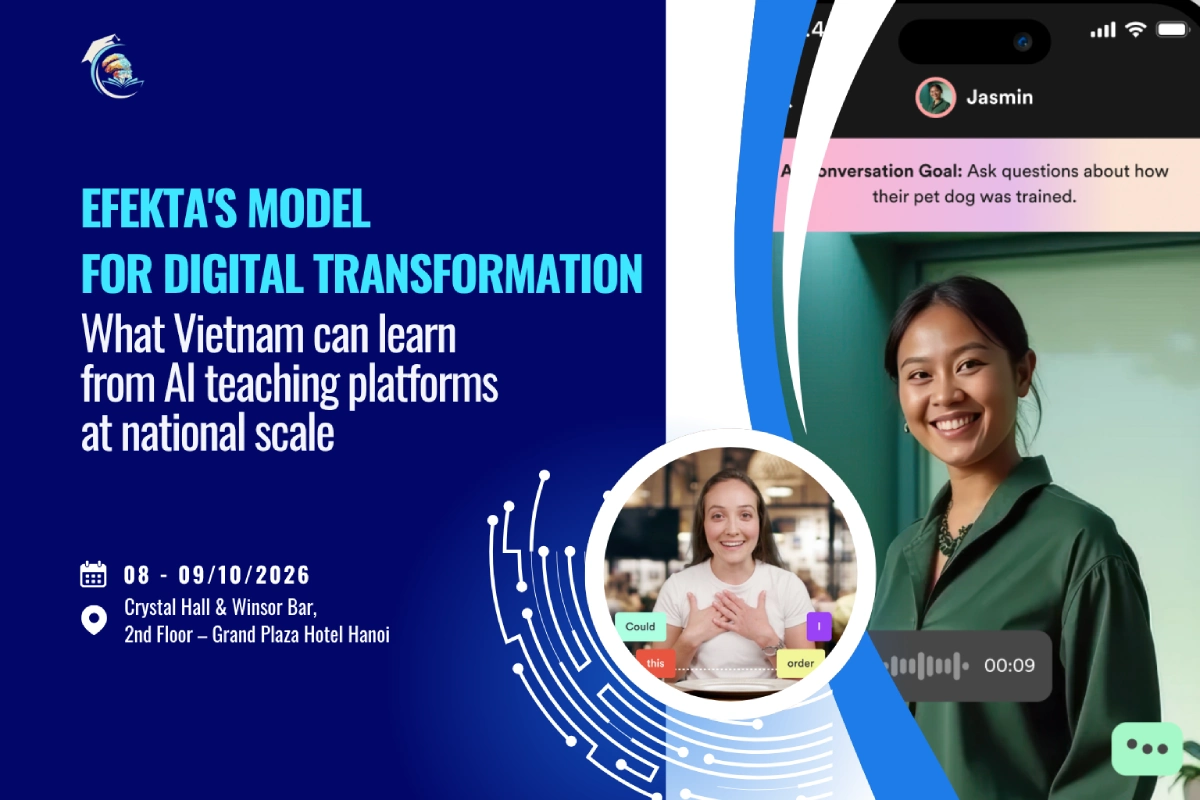
Vietnam’s education sector faces a critical challenge: too few qualified teachers, especially in English and STEM, and significant quality disparities between urban and rural regions. Yet this challenge can now be solved. Efekta Education, spun out from EF (Education First), offers an advanced Agentic Teaching Platform to governments, public and private school systems, universities and publishers, demonstrating how international expertise combined with breakthrough technology can transform education at national scale, a model Vietnam urgently needs.
Efekta’s transformational approach
Unlike generic EdTech tools, Efekta operates with full classroom context. Its Agentic Teaching Platform combines two interconnected components: an AI Learning Companion that provides personalised one-to-one support to every student, and AI Teaching Assistants that give teachers real-time insights into student progress and practical guidance. Critically, the system doesn’t replace teachers; it empowers them.
Efekta’s proprietary technology continuously measures fluency and progress across over 100 learning metrics, built on decades of research and data from millions of learners. This longitudinal approach enables unusual precision: the system doesn’t just show how well students are doing; it pinpoints exactly what they need to improve.
Results at scale
Efekta’s track record speaks volumes. In Latin America, the platform delivered over 100 million lessons to 4 million students and 25,000 teachers. In Brazil’s Paraná state, results were transformative: a 32.5% improvement in standardised English test scores within two years, with a 95% student and teacher engagement rate.
In Rwanda, Efekta launched a nationwide Teacher Training Program that scaled from 16,000 to 85,000 participants and is on track to reach 150,000 beneficiaries. Teachers showed remarkable progress, moving from CEFR A2 (Elementary) to B1 (Intermediate) proficiency across all four language skills within months. Speaking and writing, typically the most difficult skills to develop, improved as strongly as listening and reading.

Driving digital transformation and innovation in Vietnam’s education sector
Addressing teacher shortage: Efekta’s model helps teachers without specialist subject training deliver instruction closer to specialist level. AI Teaching Assistants handle repetitive drilling and individual practice, freeing teachers to lead group work and keep students motivated, extending the reach of a limited specialist workforce.
Closing regional gaps: The same platform can teach specialised subjects like AI literacy in every school, including those that could never hire a specialist. This directly addresses Vietnam’s rural education challenges.
Data-driven decision making: Schools and policymakers gain system-wide visibility into learning progress, helping identify gaps earlier and direct support where impact is greatest, and is essential for government-level educational planning.
Child safety and privacy: Efekta’s systems are built around data minimisation and user protection, with safeguards designed for school environments.
Assessment integrity: Sophisticated anti-cheating technology ensures that progress data reflects genuine learning, so schools and ministries can trust what the system reports.
What Vietnam can learn from Efekta’s model
Vietnam stands at a transformative moment. Efekta’s demonstrated ability to improve learning outcomes at scale, combined with its mission to add 100 million more students to its platform within three to five years, offers Vietnam a tested pathway to digital transformation. By partnering with established global providers, Vietnam can rapidly close educational gaps and prepare its citizens for the global economy.
Practical experience from large-scale, technology-enabled education models shows that digital transformation is not driven by technology alone. It also requires the sharing of experience, coordination of resources, and approaches that respond to the needs of each educational context.
This is one of the key areas of focus at IECEE 2026, where government agencies, educational institutions, international organisations, technology companies and education experts will come together to share experience, showcase innovative models and explore new approaches to digital education.
Efekta’s model offers a broader perspective on how AI, educational technology and modern assessment can be integrated into education at scale while remaining responsive to learners’ needs and the realities of teachers and institutions. For Vietnam, international models such as this can provide valuable reference points as the country continues to shape its own approach to digital transformation in education.
At IECEE 2026, these perspectives will contribute to a wider dialogue on how international experience, technology and local expertise can come together to support the next phase of digital education in Vietnam.