


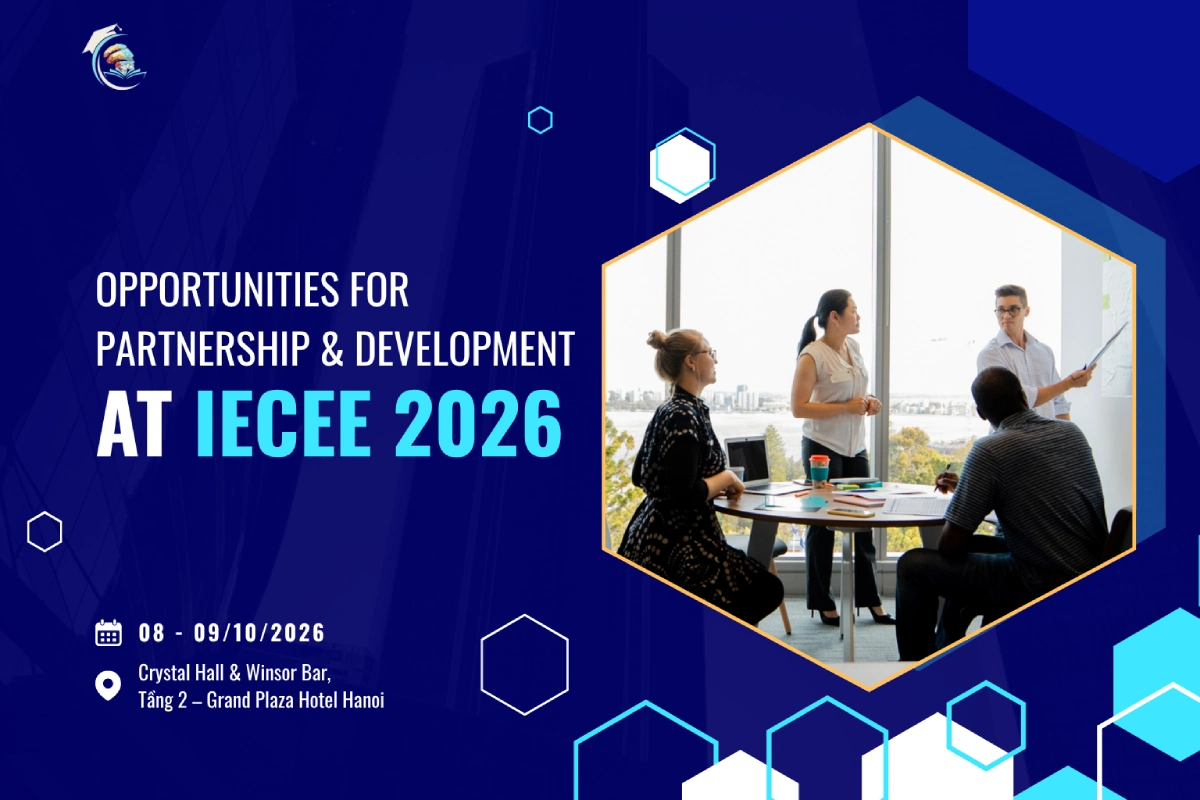
Opportunities for Partnership and Development at IECEE 2026

As education and work continue to evolve with technology, building effective solutions requires more than innovation alone. It requires collaboration between policymakers, educators, technology organizations, research institutions and assessment experts. At IECEE 2026, bringing these perspectives together can create new opportunities to connect global expertise with Vietnam’s local context, strengthen education and workforce development, and turn shared knowledge into measurable outcomes.
Why partnership matters for innovation and outcomes?
As technology reshapes education and work, the question is no longer whether education systems should innovate. It is how to ensure that innovation develops the skills learners need, reaches them equitably and produces outcomes institutions can trust.
That is the value a global partnership connecting IECEE 2026 with education and technology organizations can bring to the education community.

No single organization has a complete view of the education system. Governments establish national priorities. Educators and institutions understand learners and classrooms. Technology organizations provide tools, infrastructure and scale. Research and assessment organizations such as ETS contribute evidence, measurement expertise and a means of evaluating progress.
Bringing these capabilities together creates a shared path from policy to implementation to measurable outcomes. It can help partners identify emerging competency needs, design locally relevant solutions, build educators’ capacity and determine whether an initiative is delivering meaningful results.
Combining global expertise with Vietnam’s local context
This partnership must begin with local context. Global organizations can contribute research, technology and lessons learned across markets, but Vietnamese educators and policymakers are best positioned to define their communities’ priorities.
The goal should not be to import a uniform solution. It should be to combine global evidence with local expertise and jointly develop approaches that support Vietnam’s education and workforce ambitions.
Making skills visible through assessment

ETS advances the science of measurement because skills must be made visible before institutions can act on them. Fair and valid assessment can help educators understand learners’ strengths, identify development needs and evaluate whether programs are producing progress.
The TOEIC program provides one example of this connection. The 2026 TOEIC Global English Skills Report found that 81% of employers surveyed said the growing use of AI is increasing the need for English proficiency.
This illustrates a broader point: technology does not diminish the importance of human capabilities. It makes understanding, developing and validating those capabilities even more important.
Turning shared knowledge into opportunities for action
IECEE 2026 can turn shared knowledge into joint research, pilot programs, professional capacity-building and sustained cooperation.
Its greatest value will be measured not only by the ideas exchanged, but by the trusted solutions and expanded opportunities those partnerships create for learners.
By Ratnesh Kumar Jha, Global General Manager, Institutional Products, ETS