



The Future of Digital Education in Vietnam: Technology for People

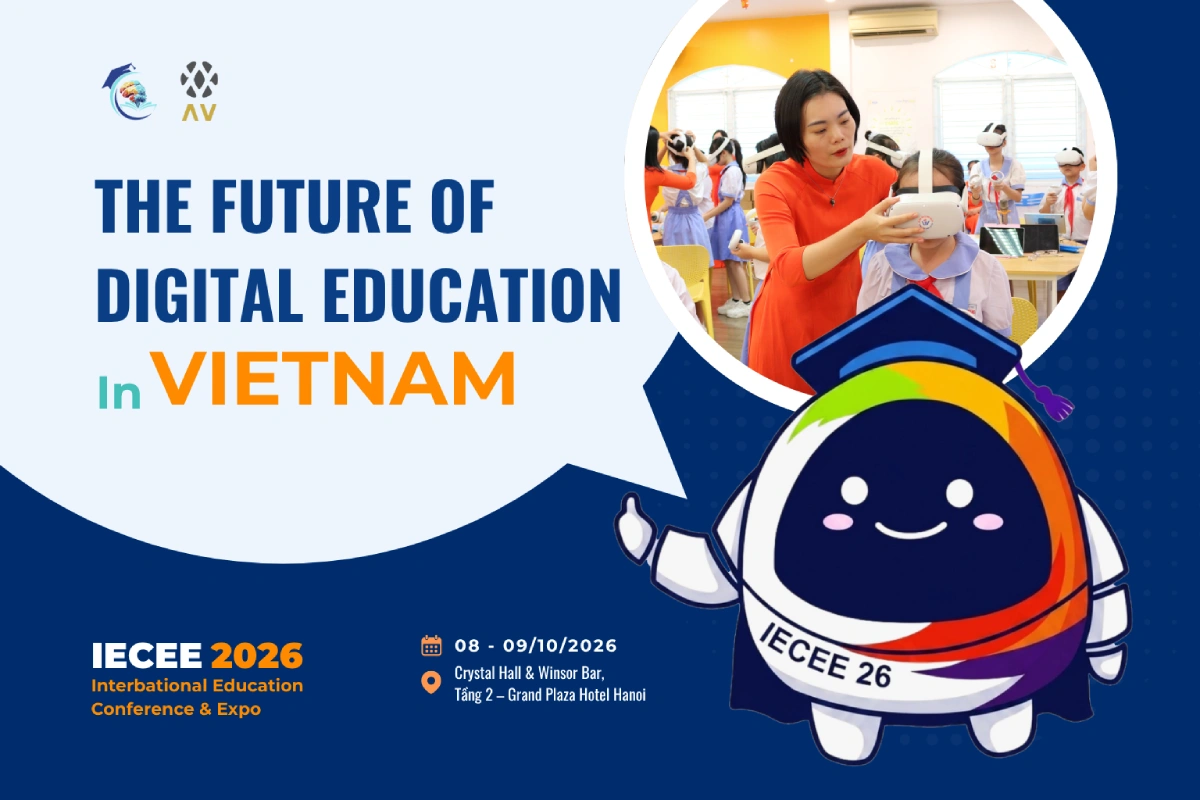
Digital transformation is creating new opportunities for education in Vietnam, from reshaping teaching and learning approaches to improving management efficiency and expanding access to knowledge.
Building on national policies and strategic directions for education development, Vietnam is gradually establishing a modern digital education ecosystem that places learners at the centre and promotes the effective use of technology. In this journey, digital transformation is not simply about technology; it is also about people, access to learning opportunities, and the ability to connect educational resources across regions.
Digital Education – Expanding Learning Opportunities in a New Era
The rapid development of artificial intelligence (AI), digital learning platforms, and data technologies is bringing profound changes to education:
- Learners have more ways to access knowledge.
- Teachers have access to additional tools to support teaching and learning.
- Educational institutions have greater opportunities to transform management and the delivery of educational programmes.
In Vietnam, digital transformation is recognised as a key driver of education modernisation. The country’s education development goals towards 2030, with a vision to 2045, call for continued educational reform, improved training quality, stronger human resource development, and greater application of science and technology in education.
However, the value of digital education goes beyond simply bringing more technology into the classroom. More importantly, technology should help expand learning opportunities, narrow gaps in access to knowledge, and bring education closer to learners—whether they live in urban centres, rural communities, mountainous areas, remote regions, or places where access to educational resources remains limited.

The Future of Digital Education: Building an Open Education Ecosystem
In the past, digital transformation in education was often understood primarily as the digitisation of learning materials or the adoption of online learning platforms. Today, however, its scope has expanded significantly.
A digital education ecosystem needs to be developed in an integrated manner, encompassing infrastructure, data, digital learning resources, management platforms, and the digital capabilities of educators and learners. When these components are effectively connected, technology can become a powerful tool for sharing educational resources more efficiently and expanding access to knowledge.
The progress of digital transformation in recent years shows that Vietnam’s education sector has gradually established large-scale education databases and developed digital academic records, digital credentials, and shared learning resources. According to the Education Journal of the Ministry of Education and Training, as reported on 12 December 2025, education databases have been developed across all levels, from early childhood education to higher education. At the same time, digital learning repositories and MOOCs are expanding access to educational resources in the digital environment.
This represents more than a technological advancement. More fundamentally, it lays the foundation for knowledge to be shared more widely, enabling learners to access educational resources less constrained by geographical distance and giving educational institutions greater opportunities to support learners through more flexible approaches.
Technology Must Go Hand in Hand with Equal Access to Learning Opportunities
One of the greatest benefits of digital transformation in education is its ability to make knowledge more widely accessible, less constrained by geographical distance or time.
Through digital platforms and online learning resources, teachers and students in different regions can access a broader range of high-quality educational materials. This creates opportunities to share knowledge, connect resources, and gradually narrow disparities in learning conditions across regions.
However, for technology to truly fulfil its potential, learners must first have meaningful access to it. Whether they live in urban or rural areas, the lowlands or mountainous regions, every child should have the opportunity to learn in an appropriate environment, develop their capabilities, and pursue their aspirations.
Ultimately, the value of digital education lies not only in new technologies, but also in its ability to connect people, expand opportunities, and contribute to a more equitable, human-centred, and inclusive education system.
Trends Shaping Vietnamese Education in 2026 – 2030
Bước vào giai đoạn phát triển mới, giáo dục Việt Nam được kỳ vọng sẽ tiếp tục chuyển mình theo nhiều xu hướng nổi bật:
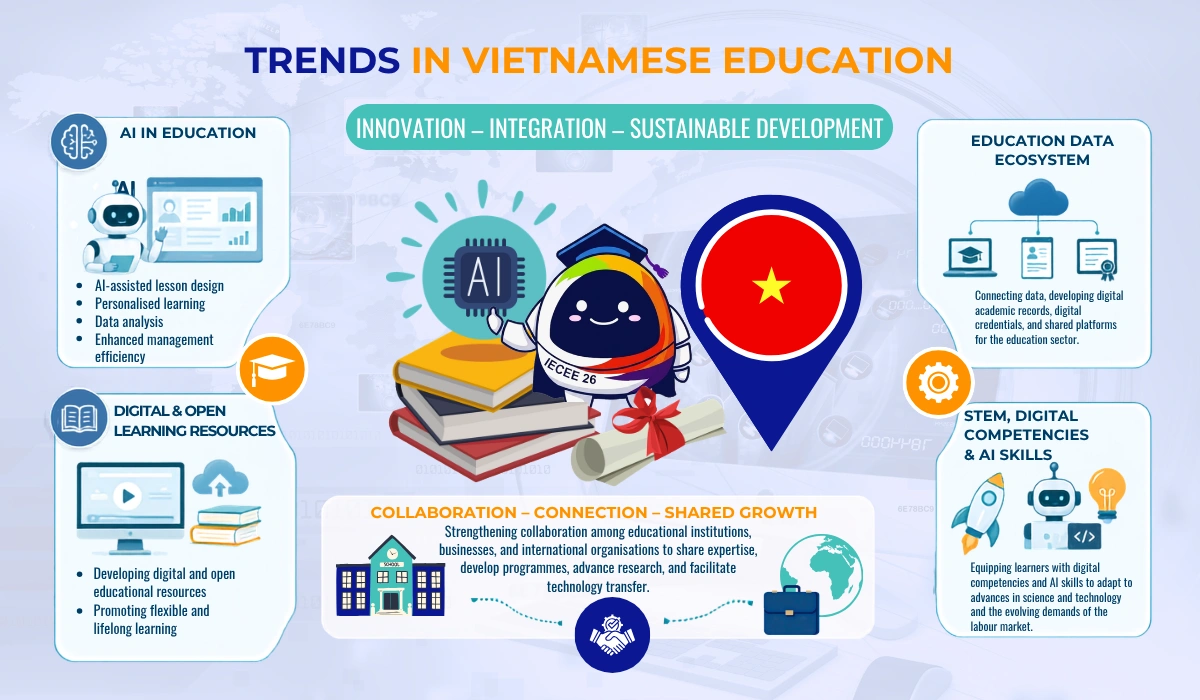
- The use of AI in education will continue to expand, supporting lesson design, personalised learning, learning analytics, and more effective educational management.
- The education data ecosystem will become increasingly integrated, through the interconnection of databases, the development of digital academic records and credentials, and shared platforms serving the education sector as a whole.
- Digital learning resources and Open Educational Resources (OER) will continue to grow, enabling learners and educators to access high-quality materials while supporting more flexible learning and lifelong learning.
- STEM education, digital competencies, and AI skills will remain key priorities, equipping learners with the capabilities they need to adapt to advances in science and technology and the evolving demands of the labour market.
Collaboration – A Key Driver of Digital Education Transformation
Digital transformation in education is a long-term journey that requires the collective efforts of multiple stakeholders, from policymakers and educational institutions to educators, technology companies, and organisations both in Vietnam and internationally. Each has a distinct role to play in translating technology into practice, sharing knowledge, and developing solutions that respond to real educational needs.
Through collaboration, knowledge exchange, and international partnerships, innovative educational models can be shared and adapted to the Vietnamese context. At the same time, new initiatives and resources can reach educators and learners more effectively.
The value of connection, therefore, goes beyond simply meeting and exchanging ideas. It is about connecting resources, knowledge, and learning opportunities so that no geographical distance becomes a barrier to learners’ aspirations for education and personal development.
IECEE 2026 – Connecting for the Future of Digital Education
Digital education is not an end in itself, but a journey towards better educational quality, broader learning opportunities, and a workforce equipped to adapt to the future.
Along this journey, IECEE 2026 – International Conference on Education Cooperation in the Digital Era & The Education & EdTech Exhibition – aims to bring together policymakers, educational institutions, EdTech companies, international organisations, experts, and stakeholders across the education ecosystem.
Co-organised by the Ministry of Education and Training of Vietnam, IECEE 2026 is expected to welcome more than 2,000 delegates, feature 70+ exhibition booths, bring together 50+ organisations, and welcome representatives from 40+ countries. Taking place on 8-9 October 2026 at the Grand Plaza Hotel Hanoi, the event will feature conference sessions, education and EdTech exhibitions, as well as a range of professional exchange and networking activities.
This will be an opportunity for policymakers, educators, educational institutions, experts, and businesses to explore the changes shaping education today and identify practical approaches that respond to the evolving needs of learners.
Nguồn tham khảo:
- https://datafiles.chinhphu.vn/cpp/files/vbpq/2025/01/1705-ttg.signed.pdf
- https://tapchigiaoduc.edu.vn/article/90490/211/chuyen-doi-so-trong-giao-duc-co-hoi-thach-thuc-va-dinh-huong-giai-doan-2026-2030/
- https://moet.gov.vn/tin-tuc/tin-tong-hop2/lay-y-kien-cho-du-thao-thong-tu-quy-dinh-ung-dung-cong-nghe-trong-giao-duc-dai-hoc.html
- https://moet.gov.vn/tin-tuc/toan-van-chi-thi-so-31-ct-ttg-ngay-05-8-2006-cua-thu-tuong-chinh-phu-ve-thuc-hien-cac-nhiem-vu-trong-tam-nam-hoc-2026-20.html
- https://moet.gov.vn/tin-tuc/hop-tac-phat-trien-trung-tam-nghien-cuu-ung-dung-ai-ve-tai-chinh-va-quan-tri.html